

Urinary Incontinence In Dogs
Abnormal urination – specifically a dog that urinates in the home – is a fairly common problem that quickly prompts a visit to the veterinarian. A thoughtful and thorough history is essential to refining the list of possible causes and determining whether it could behavioral (e.g. submissive or excitement urination) or medical in origin.
The normal urinary cycle
The kidneys and ureters are part of the upper urinary tract. Kidneys produce urine and that urine is carried to the urinary bladder by way of the ureters. Ureters normally terminate and empty the urine at a specific area in the urinary bladder called the trigone.
The lower urinary tract is comprised of the urinary bladder (which stores the urine) and the urethra (which carries urine from the urinary bladder to the genitalia where it exits the body).
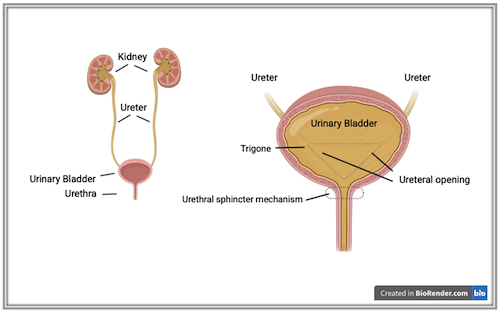
After urine is delivered to the urinary bladder, the urinary or micturition cycle begins and it is broken down into two phases:
1) Storage phase – as the urinary bladder fills with urine, the muscles in the bladder wall relax. The bladder wall stretches to accommodate filling. Urine normally does not leak out of the distended bladder because of the presence of a sphincter muscle located at the neck of the bladder. This urethral sphincter mechanism remains tightly closed until it’s time to void or empty the bladder.
2) Voiding phase – under normal circumstances the emptying of the bladder is an active and voluntary process. The individual (animal or human) initiates this process which leads to contraction of muscles in the urinary bladder and relaxation of the urethral sphincter. This allows the passage of urine from the body (urination).
Urinary incontinence is one important medical cause of abnormal urination and is broadly defined as the involuntary escape of urine from the urinary bladder during the storage phase of the urinary cycle. It has been estimated to affect approximately 1% of male dogs1 and between 3% to greater than 15% of female dogs2. There are several possible causes for urinary incontinence and a detailed history and physical examination are critical to determining a diagnosis.
Conditions that can cause pets to have “accidents” or inappropriately urinate in the home include:
- Systemic diseases that result in excessive drinking (polydipsia) or increased production of urine (polyuria) which can lead to overfilling of the bladder (e.g. diabetes mellitus or Cushing's disease).
- Lower urinary tract infections or bladder stones (cystic calculi) can lead to inappropriate urination or urge incontinence.
- Medications such as corticosteroids (e.g. prednisone) or diuretics.
Aside from these conditions - which are diagnosed by history, physical examination and/or laboratory testing - there are specific problems of the urinary tract itself that can result in urinary incontinence in dogs. These include:
- Urethral Sphincter Mechanism Incompetence (USMI): Affected dogs can often urinate normally but have an involuntary leakage of urine - typically at rest or during sleep. This condition is often associated with alterations in sex hormone levels and can develop after neutering. It occurs most commonly in female dogs – 2 to 3 years after a spay. There is evidence to show that the risk for USMI decreases for females if a spay is delayed until at least after their first estrus (heat cycle) and further decreases for every month of life (beyond the first estrus) that spaying is delayed.
- Abnormal termination of the ureters (ectopic ureters): Affected dogs often begin to have urinary incontinence at a young age and may leak urine during activity and at rest. This is a congenital abnormality in which one or both ureters terminate in a location other than the trigone of the bladder. Females are affected more commonly than males and over 25% of affected dogs have bilateral ectopic ureters. These dogs are also prone to developing recurrent urinary tract infections.
Upwards to 85% of incontinent dogs have either USMI or an ectopic ureter.
- Detrusor instability: The detrusor muscle (of the bladder) normally relaxes to allow the the bladder to fill with urine. In cases of detrusor instability, the muscle contracts unpredictably leading to intermittent incontinence. This is often a diagnosis of exclusion after other more common causes of urinary incontinence are ruled out.
- Urinary Bladder Malposition or Pelvic bladder: This is a situation in which a portion of the urinary bladder is situated in the pelvic canal resulting in a limited ability to expand with filling. Many of these dogs also have a shortened urethra and may have some dysfunction of the detrusor muscle. This is sometimes an incidental finding (on abdominal x-rays) but up to 50% of dogs with this condition have some degree of urinary incontinence.
Depending on the history and physical examination findings, a proper evaluation of urinary incontinence will often include lab work to rule in or rule out systemic illness. A urinalysis and bacterial urine culture should be performed on any dog presenting with inappropriate urination / urinary incontinence. Aside from those laboratory tests, other diagnostics that may be recommended include the following imaging modalities:
- Radiography (x-rays) with or without contrast – can help to identify bladder stones, position of the urinary bladder, and other abnormalities of the lower urinary tract
- Abdominal ultrasound – can help to identify bladder stones, ectopic ureters, and assess the kidneys
- Cystoscopy – involves the passage of a small scope up the urethra into the urinary bladder. This allows for the direct visualization of the lower urinary tract stuctures and ectopic ureters.
Treating Urinary Incontinence
Treatment is going to be tailored to the cause of urinary incontinence. With respect to specific disorders of the lower urinary tract:
- Urethral sphincter mechanism incompetence (USMI): Medical therapy is aimed at enhancing the function of the urethral sphincter.
Phenylpropanlomine (PPA) is often the first line of treatment for female and male dogs and is helpful in reducing incontinence in up to 85% of cases. Dogs should be treated for a minimum of 28 days to assess a response to treatment. This drug should not be used in dogs with hypertension (high blood pressure), diabetes mellitus, and glaucoma.
If PPA does not resolve the urinary incontinence, hormonal therapy can be considered - estrogens (estriol) for females and testosterone (testosterone cypionate or methyltestosterone) for males. The response to hormone supplementation is variable and side effects of hormone supplementation can be a concern in some patients.
There are interventional and surgical options for treating dogs with USMI:
- Urethral bulking: This involves injecting a bulking agent (e.g. collagen or other biocompatible material) into the tissues surrounding the urethra to increase the closing pressure. This material is eventually degraded by the body but has been shown to maintain continence for an average of 20.5 months. The procedure can be repeated over time.
- Hydraulic occluders: This involves the surgical placement of a silicon cuff around the urethra (near where it exits the urinary bladder). The cuff is then filled with saline and can be adjusted over time by accessing a port that is surgically positioned near the inner thigh of the animal. These have shown high rates of success in maintaining continence but do have higher rates of complication including strictures due to scar formation.
- Ectopic ureters: Treatment of choice for dogs with ectopic ureters is cystoscopic-guided laser ablation. This is a relatively noninvasive procedure and can successfully treat a majority of dogs with ectopic ureters. In some instances, surgery may be required.
Dogs with urinary incontinence are rarely cured and require some degree of chronic management with periodic follow ups. A questionnaire for pet owners was developed (Canine Urinary Incontinence Survey3) that is helpful for assessing and monitoring patients with urinary incontinence over time. Veterinarians can use the information when considering changes to treatment plans or additional diagnostics.
Urinary incontinence isn’t just an inconvenience - it can affect the quality of life of both the dog and their human(s), the pet–owner relationship, and sometimes even pet retention in the home. The more effectively we diagnose and manage these cases, the better outcomes we can provide for our patients and the families who love them.
References:
ACVIM consensus statement on diagnosis and management of urinary incontinence in dogs. (2024) J Vet Intern Med, Jan 13;38(2):878–903. https://doi.org/10.1111/jvim.16975
[1] Urinary incontinence in male dogs under primary veterinary care in England: prevalence and risk factors. (2019) J Small Anim Pract, 60:86-95. https://doi.org/10.1111/jsap.12951
[2] Urinary incontinence in bitches under primary veterinary care in England: prevalence and risk factors. (2017) J Small Anim Pract, 58:685-693. https://doi.org/10.1111/jsap.12731
[3] Canine Urinary Incontinence Survey (CUI-S) https://pmc.ncbi.nlm.nih.gov/articles/instance/10937496/bin/JVIM-38-878-s002.pdf